Digital Ship
  • Topics
    • Software, Big Data & IoT
    • Communications & Cyber Security
    • Navigation, Autonomy & New Technologies
    • Features
    • Vessel Performance
  • Markets
    • Ferry and Cruise
    • Tanker
    • Container
    • Bulk
    • Offshore Support
    • Port and Terminal
  • Summit 2026
  • Listen
  • Subscribe
  • Journals
    • AI and Automation 2026
    • Connectivity and Cyber Risk 2026
    • Data and IT Infrastructure 2026
No Result
View All Result
Digital Ship
No Result
View All Result
Summit

Digital Ship Summit 2026: Consolidation, Cyber Accountability and AI Governance

Thomas Warwick by Thomas Warwick
19 October 2026
in Features
0
Full room at Digital Ship Summit.

Full room at Digital Ship Summit.

Maritime technology leaders gathered in Athens to debate the decisions shaping digital infrastructure, cyber resilience and AI adoption.

The average ship in the global fleet is more than 22 years old. When many of today’s vessels entered service, Gmail had only just launched and the first iPhone was still years away.

Yet owners and operators expect the benefits of modern technology: greater efficiency, better visibility, stronger connectivity and safer operations.

How can the industry deliver those benefits across vessels designed to operate for decades?

That question brought maritime technology leaders together in Athens on 15 October for the Digital Ship Summit 2026.

Three sessions combined shipping-company experience with panel debates and audience questions. With minimal slides and no sales pitches, the emphasis was on examining practical decisions and challenging assumptions.

Data & IT Infrastructure: When does simplification become dependency?

Gunnar Eide, Manager of Digital Applications at Odfjell SE, described how fragmented data had frustrated efforts to optimise spare-parts management using machine learning. Vessel positions, inventories and maintenance records sat in separate systems, prompting Odfjell to consolidate data into Microsoft Fabric.

The subsequent debate examined whether consolidating technology suppliers would deliver similar benefits.

Fewer vendors can reduce integration costs but increase dependency. Others advocated retaining specialist applications connected through common standards and APIs.

The central question was how operators can simplify their technology environments without compromising data ownership, flexibility or their ability to change suppliers.

Connectivity & Cyber Resilience: Who owns the risk?

Raal Harris and Ioannis Rizos, Head of Infrastructure and Cybersecurity at Dynagas, challenged assumptions about increasing cyber threats. Improved monitoring can reveal more attempted attacks without necessarily indicating more successful breaches.

The wider discussion examined accountability across increasingly connected fleets.

Suppliers are responsible for securing their technology, but operators remain accountable for vessel operations. Social engineering, crew awareness and operational continuity during an incident remain significant concerns.

The discussion reinforced the need to define responsibilities across suppliers and operators, while ensuring critical operations can continue when systems are compromised.

AI & Automation: Can adoption outpace governance?

Peter Jackson, Chief Technology Officer at Seaspan, opened the final session with a practical examination of scaling AI across maritime organisations.

Research presented during the discussion showed that formal AI policies had increased from 11% of maritime organisations in 2025 to 35% in 2026. Yet only 25% reported consistently following those policies, while 48% acknowledged uncontrolled AI use.

The debate exposed a growing gap between adoption and organisational oversight.

The challenge is to establish reliable data, appropriate controls and clear accountability as AI moves from experimentation into operational decision-making.

Three debates, one common challenge

Across the sessions, three issues emerged: technology dependency, accountability for operational risk and the limits of automated decision-making.

No single approach will suit every fleet. Technology choices must reflect operational requirements, available expertise and the consequences of failure.

Attendees openly valued the openness of shipping-company speakers, contrasting perspectives and opportunities to exchange experience with peers.

The discussions demonstrated the value of bringing the people making these decisions into the same room, even when consensus remains elusive.

The Digital Ship Summit returns to Singapore in October 2027, continuing the discussion with maritime technology leaders facing crucial decisions across their fleets.

Tags: BulkContainerTanker
Previous Post

Signal Ocean acquires 37-year-old Telix platform to integrate maritime data and communications

Next Post

Global Maritime Leaders Arrive in Manila as Seatrade Maritime Crew Connect Global 2026 Opens

Related News

Chris Hornung, Chief Executive Officer, Deep Wave.
Features

EXCLUSIVE | Deep Wave CEO on taking Austria’s MarineXChange into its fold, opening a new cruise vertical

Group CEO Chris Hornung tells Digital Ship why the private equity-backed platform is moving beyond commercial shipping, and where AI...

by Arnel Murga
9 November 2026
Craig Wooldridge, Maritime Cyber Baseline Certification Manager, IASME.
Features

EXCLUSIVE | Maritime cyber attacks often start with basic weaknesses, says IASME

Maritime cyber attacks do not always begin with sophisticated hacking or highly organised technical operations. According to Craig Wooldridge of...

by Arnel Murga
26 October 2026
Ben Thurecht, Chief Technology Officer, Veson Nautical
Features

EXCLUSIVE | A VLCC under cyberattack is highly visible. The bigger risk is the one you can’t see. 

In August, the US Coast Guard and FBI agents boarded a tanker headed for Galveston, Texas. This unusual operation was...

by Ben Thurecht
26 October 2026
Frank Pacella, VP Sales, Maritime at Orbius
Features

EXCLUSIVE | The connected ship needs a brain, not just a faster link

The push for faster maritime connectivity is putting more attention on what ships can do with the data once they...

by Arnel Murga
16 October 2026
Christina Orfanidou, Head of Group AI at Columbia Group
Features

EXCLUSIVE | Columbia Group puts AI to work beyond the hype

Columbia Group is moving from AI experimentation to practical deployment, with applications ranging from document processing and compliance support to...

by Arnel Murga
12 October 2026
Zenon Oratis, Senior IT Director at InterMaritime Ship Management
Features

EXCLUSIVE | Cyber resilience cannot be a compliance exercise

Maritime cyber security is getting more attention from shipowners and managers, driven by regulation, connectivity and the growing number of...

by Arnel Murga
9 October 2026
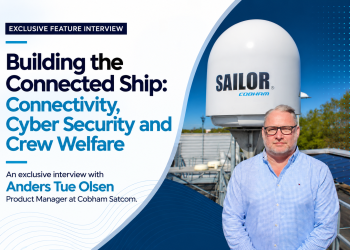
Anders Tue Olsen, Product Manager at Cobham Satcom.
Features

EXCLUSIVE | Building the Connected Ship: Connectivity, Cyber Security and Crew Welfare

Maritime communications were often viewed as a supporting function. Today, connectivity sits at the heart of how ships operate, how...

by Arnel Murga
5 October 2026
Yonghyun Jo, Ph.D., CEO of CYTUR Inc.
Features

After a cyber incident, a ship must prove it is safe to sail 

A cyber incident can delay a ship even when there is no visible damage. Owners should judge resilience by the...

by Yonghyun Jo
2 October 2026
Next Post
Global Maritime Leaders Arrive in Manila as Seatrade Maritime Crew Connect Global 2026 Opens

Global Maritime Leaders Arrive in Manila as Seatrade Maritime Crew Connect Global 2026 Opens

  • Contact
  • Cookies and Privacy

© 2026 Digital Ship Media is part of Antares Digital Group

GDPR Cookie Banner

We are using cookies to give you the best experience on our website.

No Result
View All Result
  • Topics
    • Software, Big Data & IoT
    • Communications & Cyber Security
    • Navigation, Autonomy & New Technologies
    • Features
    • Vessel Performance
  • Markets
    • Ferry and Cruise
    • Tanker
    • Container
    • Bulk
    • Offshore Support
    • Port and Terminal
  • Summit 2026
  • Listen
  • Subscribe
  • Journals
    • AI and Automation 2026
    • Connectivity and Cyber Risk 2026
    • Data and IT Infrastructure 2026

© 2026 Digital Ship Media is part of Antares Digital Group

Powered by  GDPR Cookie Compliance (opens in a new tab)
Privacy Overview

This website uses cookies so that we can provide you with the best user experience possible. Cookie information is stored in your browser and performs functions such as recognising you when you return to our website and helping our team to understand which sections of the website you find most interesting and useful.

Strictly Necessary Cookies

Strictly Necessary Cookie should be enabled at all times so that we can save your preferences for cookie settings.