Digital Ship
  • Topics
    • Software, Big Data & IoT
    • Communications & Cyber Security
    • Navigation, Autonomy & New Technologies
    • Features
    • Vessel Performance
  • Markets
    • Ferry and Cruise
    • Tanker
    • Container
    • Bulk
    • Offshore Support
    • Port and Terminal
  • Summit 2026
  • Listen
  • Subscribe
  • Journals
    • AI and Automation 2026
    • Connectivity and Cyber Risk 2026
    • Data and IT Infrastructure 2026
No Result
View All Result
Digital Ship
No Result
View All Result
Summit

EXCLUSIVE | Maritime cyber attacks often start with basic weaknesses, says IASME

Arnel Murga by Arnel Murga
26 October 2026
in Features
0
Craig Wooldridge, Maritime Cyber Baseline Certification Manager, IASME.

Craig Wooldridge, Maritime Cyber Baseline Certification Manager, IASME.

Maritime cyber attacks do not always begin with sophisticated hacking or highly organised technical operations. According to Craig Wooldridge of UK cyber security assurance company IASME, many incidents can be traced to familiar weaknesses such as poor password practices, exposed remote access, unpatched systems and compromised supplier accounts.

Wooldridge, who has an 18-year background in criminal fraud and worked with the West Midlands Police Economic Crime Team, the Regional Organised Crime Unit and the National Fraud Intelligence Bureau, said the maritime industry can sometimes picture cyber attacks as highly sophisticated operations.

“People imagine a sophisticated attacker breaking into a ship’s systems, like something out of a James Bond film,” he said. “But in reality, many incidents start in far more ordinary ways.”

The gap between policy and the ship

One of the biggest challenges is making sure that cyber security policies work in the environment where they are needed most.

Wooldridge said companies may have rules requiring least-privilege access and prohibiting shared accounts, yet crews can still encounter shared logins, generic administrator accounts and reused passwords because they are convenient when people are working under pressure.

Patching is another problem. Ships operate continuously and maintenance windows can be limited by operational requirements, connectivity constraints and vendor dependencies. Some onboard systems can also remain in service for years, beyond the normal support timelines associated with IT equipment.

Incident response plans can face a similar problem.

“Crews need a simple vessel-ready document or book of what to isolate, who to call, and what to keep running safely,” Wooldridge said.

He stressed that procedures written for shore-based teams need to be adapted for crews at sea and the cyber security measures explained in plain English to the crew that will be using them. Crew training is as important as technical controls: a system is only effective if people know how to use it and respond to an incident. 

“The training of your crew could stop a major disaster from happening.”

Remote access and suppliers remain exposed

The wider maritime technology ecosystem also creates potential routes for attackers. Ships now interact with connected IT and operational technology systems, shore-based infrastructure, vendors and other third parties.

Wooldridge identified remote access and third-party support as particular areas of concern, especially where vendor access is not properly controlled or logged.

A compromised supplier account can provide a route into multiple organisations, while poor separation between business networks, crew networks and operational systems can allow an initial compromise to spread.

Asset visibility is another issue.

“If you don’t have a reliable view of what systems you have on board and how they connect with each other, you can’t manage the risk effectively,” he said.

For Wooldridge, cyber resilience is about more than keeping attackers out. “It’s not just prevention. It’s being able to operate safely through a disruption.”

That distinction matters in maritime operations; vessels cannot simply stop sailing when there is an IT problem.

A baseline for maritime cyber hygiene

Wooldridge believes certification can help turn cyber security policies into practical controls by giving shipowners, managers, charterers, insurers and regulators a common framework.

“A baseline certification changes the behaviour when it sets clear expectations, requires evidence and gives the industry a common language,” he said.

IASME’s Maritime Cyber Baseline scheme is designed around the IMO’s cyber risk management guidance. Wooldridge said it focuses on practical controls covering areas such as asset awareness, access control, patching, vulnerability management, remote access, network separation, supplier access, backups and incident response.

The approach is intended to address three areas: reducing the ways attackers can get in, limiting how far an incident can spread and improving recovery when an incident occurs.

For shipowners unsure where to start, Wooldridge suggests a few priorities: control access, understand critical systems and limit the potential spread of an incident, and make recovery practical for the crew.

In practice, this means, controlling remote access, removing unmanaged accounts, understanding which systems are critical, separating networks where appropriate, protecting backups and testing restores.

It also means having an incident response process that works at sea.

“Most maritime cyber incidents don’t start with sophisticated hacking. They start with a basic weakness,” Wooldridge noted.

Cyber resilience starts with getting the basics right, then making sure those basics can actually be followed onboard.

Previous Post

82% of seafarers say training fails to prepare crews for digital ship operations

Next Post

Sweden contracts Saildrone for 1,440 days of unmanned Baltic Sea surveillance

Related News

Chris Hornung, Chief Executive Officer, Deep Wave.
Features

EXCLUSIVE | Deep Wave CEO on taking Austria’s MarineXChange into its fold, opening a new cruise vertical

Group CEO Chris Hornung tells Digital Ship why the private equity-backed platform is moving beyond commercial shipping, and where AI...

by Arnel Murga
9 November 2026
Ben Thurecht, Chief Technology Officer, Veson Nautical
Features

EXCLUSIVE | A VLCC under cyberattack is highly visible. The bigger risk is the one you can’t see. 

In August, the US Coast Guard and FBI agents boarded a tanker headed for Galveston, Texas. This unusual operation was...

by Ben Thurecht
26 October 2026
Full room at Digital Ship Summit.
Features

Digital Ship Summit 2026: Consolidation, Cyber Accountability and AI Governance

Maritime technology leaders gathered in Athens to debate the decisions shaping digital infrastructure, cyber resilience and AI adoption. The average...

by Thomas Warwick
19 October 2026
Frank Pacella, VP Sales, Maritime at Orbius
Features

EXCLUSIVE | The connected ship needs a brain, not just a faster link

The push for faster maritime connectivity is putting more attention on what ships can do with the data once they...

by Arnel Murga
16 October 2026
Christina Orfanidou, Head of Group AI at Columbia Group
Features

EXCLUSIVE | Columbia Group puts AI to work beyond the hype

Columbia Group is moving from AI experimentation to practical deployment, with applications ranging from document processing and compliance support to...

by Arnel Murga
12 October 2026
Zenon Oratis, Senior IT Director at InterMaritime Ship Management
Features

EXCLUSIVE | Cyber resilience cannot be a compliance exercise

Maritime cyber security is getting more attention from shipowners and managers, driven by regulation, connectivity and the growing number of...

by Arnel Murga
9 October 2026
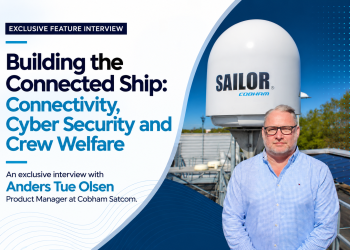
Anders Tue Olsen, Product Manager at Cobham Satcom.
Features

EXCLUSIVE | Building the Connected Ship: Connectivity, Cyber Security and Crew Welfare

Maritime communications were often viewed as a supporting function. Today, connectivity sits at the heart of how ships operate, how...

by Arnel Murga
5 October 2026
Yonghyun Jo, Ph.D., CEO of CYTUR Inc.
Features

After a cyber incident, a ship must prove it is safe to sail 

A cyber incident can delay a ship even when there is no visible damage. Owners should judge resilience by the...

by Yonghyun Jo
2 October 2026
Next Post
Photo from Saildrone.

Sweden contracts Saildrone for 1,440 days of unmanned Baltic Sea surveillance

  • Contact
  • Cookies and Privacy

© 2026 Digital Ship Media is part of Antares Digital Group

GDPR Cookie Banner

We are using cookies to give you the best experience on our website.

No Result
View All Result
  • Topics
    • Software, Big Data & IoT
    • Communications & Cyber Security
    • Navigation, Autonomy & New Technologies
    • Features
    • Vessel Performance
  • Markets
    • Ferry and Cruise
    • Tanker
    • Container
    • Bulk
    • Offshore Support
    • Port and Terminal
  • Summit 2026
  • Listen
  • Subscribe
  • Journals
    • AI and Automation 2026
    • Connectivity and Cyber Risk 2026
    • Data and IT Infrastructure 2026

© 2026 Digital Ship Media is part of Antares Digital Group

Powered by  GDPR Cookie Compliance (opens in a new tab)
Privacy Overview

This website uses cookies so that we can provide you with the best user experience possible. Cookie information is stored in your browser and performs functions such as recognising you when you return to our website and helping our team to understand which sections of the website you find most interesting and useful.

Strictly Necessary Cookies

Strictly Necessary Cookie should be enabled at all times so that we can save your preferences for cookie settings.