Digital Ship
  • Topics
    • Software, Big Data & IoT
    • Communications & Cyber Security
    • Navigation, Autonomy & New Technologies
    • Features
    • Vessel Performance
  • Markets
    • Ferry and Cruise
    • Tanker
    • Container
    • Bulk
    • Offshore Support
    • Port and Terminal
  • Summit 2026
  • Listen
  • Subscribe
  • Journals
    • AI and Automation 2026
    • Connectivity and Cyber Risk 2026
    • Data and IT Infrastructure 2026
No Result
View All Result
Digital Ship
No Result
View All Result
Summit

Greek shipping wants proof before investing in AI

Arnel Murga by Arnel Murga
25 August 2026
in Features
0
Nicolas Timpelis, IT Projects Support Manager at Ionic

Nicolas Timpelis, IT Projects Support Manager at Ionic

Artificial intelligence is appearing across more parts of fleet operations, from voyage planning and emissions reporting to predictive maintenance. For many shipowners, buying AI is not the objective. Solving operational problems is. That is how Nicolas Timpelis, IT Projects Support Manager at Ionic, believes the industry should approach the technology.

“Greek shipping has always been an industry that balances innovation with operational excellence,” he says.

“We do not invest because something is labelled ‘AI’. We invest when it solves a real operational problem and delivers measurable value.”

He says companies are already finding practical uses for AI where reliable operational data is available.

“We are now seeing AI deployed in specific operational areas where sufficient data exists and there is a clear business case, such as voyage optimization, emissions reporting and predictive maintenance.”

Even so, he believes shipowners should be cautious.

“The challenge today is determining which solutions are worth investing in, both financially and operationally, when almost every vendor claims to have an AI-powered product.”

For Timpelis, the discussion should be about confidence rather than novelty.

“That is why I believe the next phase is not about deploying more AI, but about deploying trusted AI.”

Good data matters more than clever algorithms

Timpelis believes many AI projects succeed or fail long before any algorithm is introduced.

“If there is one challenge that almost every shipping company faces today, it is data.”

“They are spread across multiple software platforms, different databases, and in many cases still exist in hard-copy format. Bringing all of these together into a structured and reliable data environment is a demanding process, but it is absolutely essential.”

Without reliable information, AI cannot deliver reliable recommendations.

“Without trusted data, AI cannot produce trusted results, and the risk of inaccurate and/or hallucinated results increases significantly. As they say, ‘Garbage in, garbage out’.”

He says every AI proposal at Ionic is judged against one practical test.

“Whenever we evaluate a new AI solution internally, the first question we ask is simple: Will this solution help our people make better decisions?”

That approach has shaped the company’s view of successful AI deployments.

“From what I’ve seen, the AI projects that succeed are not necessarily the most sophisticated ones. They are the ones that solve real operational problems, fit naturally into existing workflows, and, most importantly, earn the trust of the people using them every day.”

He adds that results should be measured in operational terms rather than technical complexity.

“Ultimately, success is measured by improvements in safety, efficiency, compliance, and operational performance. It is not measured by the complexity of the algorithms behind them.”

People remain responsible

While AI is taking on more operational tasks, Timpelis does not see it replacing the judgement of experienced seafarers or shore teams.

“AI can analyze information, identify patterns, and generate recommendations, but it cannot replace seamanship, operational judgement, or human accountability.”

“It is seamanship that has made our industry what it is today, and it is seamanship that will continue to lead it forward. AI simply gives us another powerful tool to further reduce the risks associated with the human element.”

He also believes governance will play a growing role as shipping companies introduce AI into everyday operations.

“It establishes accountability, defines how AI models are validated, and ensures that AI recommendations remain transparent and auditable.”

Timpelis expects organisations such as the IMO and IACS to contribute to common standards for the responsible use of AI, while shipping companies continue investing in data quality, cyber security and workforce skills alongside new technology.

Digital Ship Summit

These are some of the issues Timpelis hopes to discuss at this year’s Digital Ship Summit, where AI and automation will be one of the key themes.

“For me, the discussion is no longer whether AI has a place in shipping. It clearly does.”

“The real question is whether we can scale it responsibly. That means strong governance, trusted data, transparency, and human oversight. That is exactly the conversation I am looking forward to having at this year’s Digital Ship Summit.”

For Timpelis, AI has already earned a place in shipping. The task now is making sure every recommendation is backed by reliable data and every decision remains in human hands.

Previous Post

COSL cuts rig fuel use by more than 50% through digital energy management

Next Post

SEA.AI and Anschütz bring machine vision into autonomous bridge systems

Related News

Chris Hornung, Chief Executive Officer, Deep Wave.
Features

EXCLUSIVE | Deep Wave CEO on taking Austria’s MarineXChange into its fold, opening a new cruise vertical

Group CEO Chris Hornung tells Digital Ship why the private equity-backed platform is moving beyond commercial shipping, and where AI...

by Arnel Murga
9 November 2026
Craig Wooldridge, Maritime Cyber Baseline Certification Manager, IASME.
Features

EXCLUSIVE | Maritime cyber attacks often start with basic weaknesses, says IASME

Maritime cyber attacks do not always begin with sophisticated hacking or highly organised technical operations. According to Craig Wooldridge of...

by Arnel Murga
26 October 2026
Ben Thurecht, Chief Technology Officer, Veson Nautical
Features

EXCLUSIVE | A VLCC under cyberattack is highly visible. The bigger risk is the one you can’t see. 

In August, the US Coast Guard and FBI agents boarded a tanker headed for Galveston, Texas. This unusual operation was...

by Ben Thurecht
26 October 2026
Full room at Digital Ship Summit.
Features

Digital Ship Summit 2026: Consolidation, Cyber Accountability and AI Governance

Maritime technology leaders gathered in Athens to debate the decisions shaping digital infrastructure, cyber resilience and AI adoption. The average...

by Thomas Warwick
19 October 2026
Frank Pacella, VP Sales, Maritime at Orbius
Features

EXCLUSIVE | The connected ship needs a brain, not just a faster link

The push for faster maritime connectivity is putting more attention on what ships can do with the data once they...

by Arnel Murga
16 October 2026
Christina Orfanidou, Head of Group AI at Columbia Group
Features

EXCLUSIVE | Columbia Group puts AI to work beyond the hype

Columbia Group is moving from AI experimentation to practical deployment, with applications ranging from document processing and compliance support to...

by Arnel Murga
12 October 2026
Zenon Oratis, Senior IT Director at InterMaritime Ship Management
Features

EXCLUSIVE | Cyber resilience cannot be a compliance exercise

Maritime cyber security is getting more attention from shipowners and managers, driven by regulation, connectivity and the growing number of...

by Arnel Murga
9 October 2026
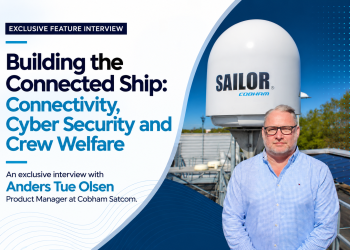
Anders Tue Olsen, Product Manager at Cobham Satcom.
Features

EXCLUSIVE | Building the Connected Ship: Connectivity, Cyber Security and Crew Welfare

Maritime communications were often viewed as a supporting function. Today, connectivity sits at the heart of how ships operate, how...

by Arnel Murga
5 October 2026
Next Post
Photo from Sea.Ai.

SEA.AI and Anschütz bring machine vision into autonomous bridge systems

  • Contact
  • Cookies and Privacy

© 2026 Digital Ship Media is part of Antares Digital Group

GDPR Cookie Banner

We are using cookies to give you the best experience on our website.

No Result
View All Result
  • Topics
    • Software, Big Data & IoT
    • Communications & Cyber Security
    • Navigation, Autonomy & New Technologies
    • Features
    • Vessel Performance
  • Markets
    • Ferry and Cruise
    • Tanker
    • Container
    • Bulk
    • Offshore Support
    • Port and Terminal
  • Summit 2026
  • Listen
  • Subscribe
  • Journals
    • AI and Automation 2026
    • Connectivity and Cyber Risk 2026
    • Data and IT Infrastructure 2026

© 2026 Digital Ship Media is part of Antares Digital Group

Powered by  GDPR Cookie Compliance (opens in a new tab)
Privacy Overview

This website uses cookies so that we can provide you with the best user experience possible. Cookie information is stored in your browser and performs functions such as recognising you when you return to our website and helping our team to understand which sections of the website you find most interesting and useful.

Strictly Necessary Cookies

Strictly Necessary Cookie should be enabled at all times so that we can save your preferences for cookie settings.