Digital Ship
  • Topics
    • Software, Big Data & IoT
    • Communications & Cyber Security
    • Navigation, Autonomy & New Technologies
    • Features
    • Vessel Performance
  • Markets
    • Ferry and Cruise
    • Tanker
    • Container
    • Bulk
    • Offshore Support
    • Port and Terminal
  • Summit 2026
  • Listen
  • Subscribe
  • Journals
    • AI and Automation 2026
    • Connectivity and Cyber Risk 2026
    • Data and IT Infrastructure 2026
No Result
View All Result
Digital Ship
No Result
View All Result
Summit

Places of refuge: Why ports must lead with judgement, not instinct

Harry Palmer by Harry Palmer
10 August 2026
in Features
0
Photo from Digital Ship.

Photo from Digital Ship.

When a ship in distress calls, the pressure on a port to respond is immediate and intense. Anyone who has worked through one of these situations appreciates how complex they can be. Places of refuge are rare, high-stakes events, and how a port responds in those first critical hours will shape everything that follows.

Too often, ports frame the decision as a two-option choice – accept or refuse. The more useful question is where the risk can be best managed, and that shift in perspective changes the entire approach.

A reflexive refusal can feel like the safe option as the liability stays offshore. But refusing a distressed ship does not make the hazard disappear; it can push the situation into less controlled waters, where conditions are harder to monitor, specialist resources are harder to deploy, and the consequences of escalation are harder to contain. A knee-jerk refusal can make things worse, and the defensible decision is risk-led, not reaction-led.

Equally, unconditional acceptance without a structured assessment is no answer either. The goal is to advise accurately, based on a clear-eyed evaluation of where control can be best established and maintained.

Refuge is a spectrum, not a destination

One of the most persistent misconceptions is that refuge automatically means bringing a ship alongside a berth. In many situations, the safest and most appropriate outcome is an anchorage, sheltered waters, or a managed offshore position that allows stabilisation and assessment without importing the hazard into a populated, infrastructure-dense environment.

Ports should think of refuge as a spectrum of options. A ship can be granted a controlled position that enables specialist response and careful evaluation, without the exposures created by immediate berthing. The right answer may be to keep the risk away from the port estate while still providing meaningful support and coordination. That is still refuge and leadership.

Another assumption that consistently catches ports off guard is duration. A ship granted refuge is unlikely to stay for a matter of days. Once granted refuge, departure is rarely swift – the ship may remain for weeks or months, particularly where cargo discharge, investigation, repair, or regulatory processes are involved, which ultimately change the entire planning baseline.

Ports must think from the outset about berth availability, commercial operations, how cordons and access routes will be sustained, and how communication will be managed as the situation develops. One of the most common and consequential planning errors made by ports is treating a refuge situation as a short stabilisation exercise.

Space, cargo, and the hazards that define the risk

When a casualty ship arrives, attention tends to focus on where to put it, but the real constraint is often space. Significant controlled areas will be needed for damaged or contaminated cargo, waste streams, quarantine zones, and temporary storage pending inspection or disposal. Without that capacity, a ship incident can escalate to a port-wide operational problem.

It is also frequently the cargo, not the ship itself, that defines the true risk profile. Materials that appear entirely benign can become highly volatile when heated, wet, or structurally compromised. Cargo behaviour directly drives handling methodology, equipment requirements, and most critically, the safety of the people managing the response. Early cargo-led assessment is therefore a primary consideration.

Fire represents the sharpest end of this challenge. Shipboard fires are unpredictable and technically complex, and they can present landside emergency responders with environments they have never encountered. Accepting a ship with an active fire risk transferring a high-heat, toxic hazard into a populated, infrastructure-dense environment. This is why pro-active engagement with local fire and rescue services matters, not just to share information, but to rehearse access, water supply, foam capability, and air monitoring well before any incident occurs. The worst moment to discover a critical gap is after the ship is already alongside.

Preparedness, not luck

Where refuge situations are handled well, the difference lies in clear decision-making frameworks, established relationships with salvors, insurers, and authorities, and pre-identified refuge options tested through exercises and scenario planning. 

That preparedness enables proportionate decision-making: a well-prepared port can say no when the risk is unacceptable and say yes with appropriate controls when it is not. That operational discipline that lies within the ability to assess, decide, and sustain a response over time is what separates a port that manages a refuge situation from one that is managed by it.

Refuge is about where the risk can be best managed, and getting that judgement right, under pressure and in the full glare of public and regulatory scrutiny, is one of the most demanding things a port will ever be asked to do. The ports that are ready for it are the ones that started preparing long before the call came in.

Tags: Port and Terminal
Previous Post

ADNOC L&S cuts smart port service sourcing from 3 hours to 45 seconds

Next Post

Why port data deserves the same attention as vessel data

Related News

Chris Hornung, Chief Executive Officer, Deep Wave.
Features

EXCLUSIVE | Deep Wave CEO on taking Austria’s MarineXChange into its fold, opening a new cruise vertical

Group CEO Chris Hornung tells Digital Ship why the private equity-backed platform is moving beyond commercial shipping, and where AI...

by Arnel Murga
9 November 2026
Craig Wooldridge, Maritime Cyber Baseline Certification Manager, IASME.
Features

EXCLUSIVE | Maritime cyber attacks often start with basic weaknesses, says IASME

Maritime cyber attacks do not always begin with sophisticated hacking or highly organised technical operations. According to Craig Wooldridge of...

by Arnel Murga
26 October 2026
Ben Thurecht, Chief Technology Officer, Veson Nautical
Features

EXCLUSIVE | A VLCC under cyberattack is highly visible. The bigger risk is the one you can’t see. 

In August, the US Coast Guard and FBI agents boarded a tanker headed for Galveston, Texas. This unusual operation was...

by Ben Thurecht
26 October 2026
Full room at Digital Ship Summit.
Features

Digital Ship Summit 2026: Consolidation, Cyber Accountability and AI Governance

Maritime technology leaders gathered in Athens to debate the decisions shaping digital infrastructure, cyber resilience and AI adoption. The average...

by Thomas Warwick
19 October 2026
Frank Pacella, VP Sales, Maritime at Orbius
Features

EXCLUSIVE | The connected ship needs a brain, not just a faster link

The push for faster maritime connectivity is putting more attention on what ships can do with the data once they...

by Arnel Murga
16 October 2026
Christina Orfanidou, Head of Group AI at Columbia Group
Features

EXCLUSIVE | Columbia Group puts AI to work beyond the hype

Columbia Group is moving from AI experimentation to practical deployment, with applications ranging from document processing and compliance support to...

by Arnel Murga
12 October 2026
Zenon Oratis, Senior IT Director at InterMaritime Ship Management
Features

EXCLUSIVE | Cyber resilience cannot be a compliance exercise

Maritime cyber security is getting more attention from shipowners and managers, driven by regulation, connectivity and the growing number of...

by Arnel Murga
9 October 2026
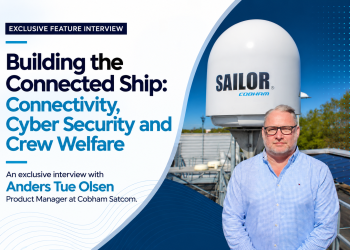
Anders Tue Olsen, Product Manager at Cobham Satcom.
Features

EXCLUSIVE | Building the Connected Ship: Connectivity, Cyber Security and Crew Welfare

Maritime communications were often viewed as a supporting function. Today, connectivity sits at the heart of how ships operate, how...

by Arnel Murga
5 October 2026
Next Post
Photo from Digital Ship.

Why port data deserves the same attention as vessel data

  • Contact
  • Cookies and Privacy

© 2026 Digital Ship Media is part of Antares Digital Group

GDPR Cookie Banner

We are using cookies to give you the best experience on our website.

No Result
View All Result
  • Topics
    • Software, Big Data & IoT
    • Communications & Cyber Security
    • Navigation, Autonomy & New Technologies
    • Features
    • Vessel Performance
  • Markets
    • Ferry and Cruise
    • Tanker
    • Container
    • Bulk
    • Offshore Support
    • Port and Terminal
  • Summit 2026
  • Listen
  • Subscribe
  • Journals
    • AI and Automation 2026
    • Connectivity and Cyber Risk 2026
    • Data and IT Infrastructure 2026

© 2026 Digital Ship Media is part of Antares Digital Group

Powered by  GDPR Cookie Compliance (opens in a new tab)
Privacy Overview

This website uses cookies so that we can provide you with the best user experience possible. Cookie information is stored in your browser and performs functions such as recognising you when you return to our website and helping our team to understand which sections of the website you find most interesting and useful.

Strictly Necessary Cookies

Strictly Necessary Cookie should be enabled at all times so that we can save your preferences for cookie settings.