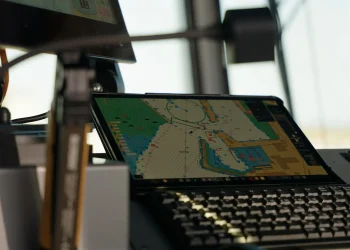
Mapsea has secured multi-million-dollar R&D funding through Korea’s 2026 Scale-up TIPS programme to advance its AI-powered S-100 ECDIS. The proposition goes beyond electronic charts, using large-scale voyage data and vessel-specific models to bring route planning, fuel use and carbon considerations into the navigation workflow.
Mapsea Corporation has secured multi-million-dollar R&D funding under Korea’s 2026 Scale-up TIPS programme as it works on an AI-powered S-100 ECDIS aimed at the global navigation market.
The Korean maritime technology company says its route engine draws on 150 billion trajectory records alongside weather, currents, depth and vessel-specific performance and fuel models. The system is designed to recommend routes based on safety, weather conditions, economics and carbon emissions, while showing the reasoning behind its recommendations.
That last element matters for shipowners and ship managers considering how much authority to give digital navigation systems. A route recommendation can be technically impressive, but its usefulness on a commercial vessel also depends on whether Masters and shore teams can understand why a particular route has been proposed and assess it against operational priorities.
Mapsea’s S-100 ECDIS work builds on an AI route engine that the company says has already been recognised through two consecutive CES Innovation Awards and Korean Register new-technology certification.
The company also cites engagement with RightShip, BNK Venture Capital and Infineon Technologies as part of its wider work across the maritime technology sector.
The Scale-up TIPS funding gives Mapsea additional resources to bring its S-100 ECDIS towards the global market. The company describes the system as part of the next generation of electronic navigation, but its relevance to fleet management will ultimately rest on how effectively the technology connects navigation decisions with fuel consumption, weather exposure and emissions.
This creates a more practical test of AI at sea. The question is not simply whether an ECDIS can recommend a route, but whether it can give navigators useful evidence to make a better one.