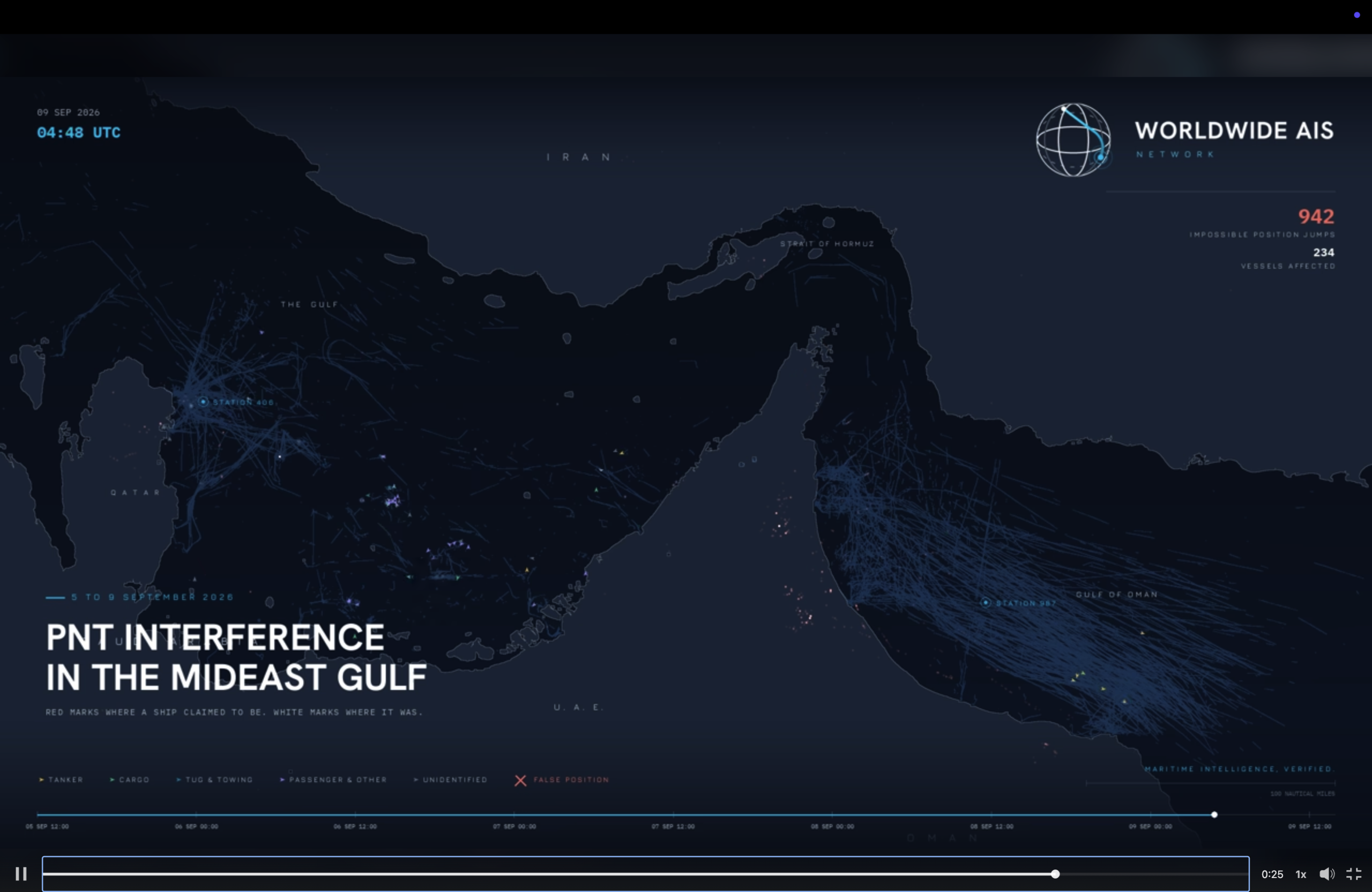
Worldwide AIS Network says it detected 1,702 physically impossible AIS position jumps across 379 vessels in the Gulf of Oman, showing how manipulated navigation data can reach the systems used by shipowners and managers. Its Copenhagen network is designed to verify AIS data at the point of reception, before corrupted records are filtered from commercial datasets.
A receiving station in Varna, Bulgaria, recently detected four tankers in the Black Sea transmitting 27 AIS reports from a single 1 km area in Lima, Peru, 12,129 km away. Worldwide AIS Network said the anomaly was identified as the signals arrived, rather than after the data had entered a wider tracking database.
This shows a problem for shipowners and managers that goes beyond navigation. AIS data is now used in sanctions screening, insurance and cargo pricing, yet the system itself has no mechanism to verify whether the information transmitted by a vessel is genuine.
Between 2 and 9 September, Worldwide AIS Network recorded 1,702 physically impossible jumps involving 379 vessels in the Gulf of Oman. At midnight UTC on 9 September, almost one third of the area’s AIS reports arrived with the vessel’s own navigation system marked as inoperative. The company has also recorded interference in the Baltic during September.
“I’ve been staring at interference data for weeks, and what keeps me up at night is that almost every network deals with it after the fact,” said Dr Owen Taylor, CEO and co-founder of Worldwide AIS Network. “When our Varna receiver showed four tankers sitting in Lima, we immediately knew the truth. Everyone else is analysing interference after the fact. We catch it the moment it happens.”
The company’s approach uses cryptography and triangulation to assess AIS transmissions at reception. Its MastChain network has live receiving stations across more than 40 countries, with some equipped to detect interference.
The issue is data integrity. A clean AIS feed can hide the evidence that a vessel’s navigation data was manipulated, leaving operators to make commercial or compliance decisions without knowing that the underlying information was compromised.